

LipoBiocat
Project overview

Robust and selective lipolytic biocatalysts for industrial applications
The manufacturing in the chemical industry still relies on classical chemical routes in which high temperatures and harsh reaction conditions are required. The usage of enzymes as biocatalysts can overcome this challenge and allow reactions at lower temperatures, reducing energy demand but, at the same time, increasing speed and efficiency by, for example, avoiding additional reaction steps like functional group protection. Currently, the application of biocatalysis in the synthesis routes is limited to a few single steps because there is a significant lack of enzymes showing a predictable behaviour during process development.
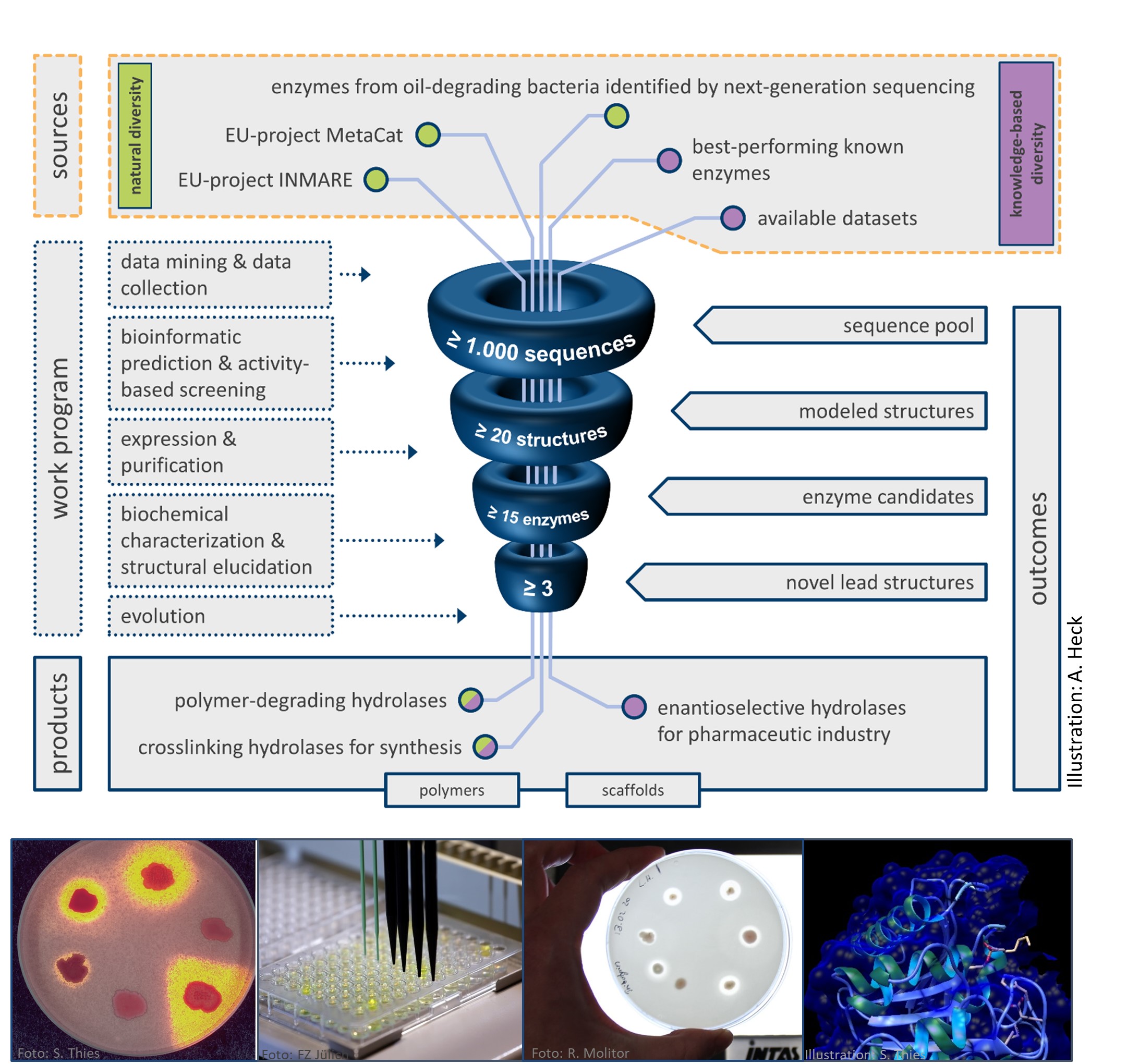
The LipoBiocat project, funded by the Federal Ministry of Education and Research in the framework of the German “National Research Strategy Bioeconomy 2030“ in the program „Tailor-made biobased ingredients for a competitive bioeconomy”, aims to provide solutions for biocatalytic challenges as identified by two important chemical industries. The usage of enzymes as biocatalysts can allow reactions at lower temperatures, reduce energy demand but, at the same time, increase speed and efficiency by, for example, avoiding additional reaction steps. However, enzymes have been evolved by nature to work in living cells and under mild reaction conditions; consequently, most enzymes do not operate properly and cost-efficiently in industrial processes with artificial substrates. LipoBiocat aims to identify and provide suitable biocatalysts by the following approaches: (i) Natural enzyme diversity will be used to identify new enzymes for the synthesis and “on demand” hydrolysis of polymers. Here, an innovative peptide-mediated adhesion technology will be established to enhance polymer binding and hydrolysis efficiency. (ii) Knowledge-based enzyme diversity will be created by applying a newly developed computational workflow to construct promiscuous and robust enzymes to serve as a blueprint for a rapid identification also of other industrially relevant enzymes.
In phase 2, the project addresses specifically the globally relevant problem of the accumulation of large quantities of plastic in the environment. In recent years, the enzymatic degradation of plastic polymers has become increasingly important for science, the public and the economy, as it can be used to achieve a sustainable approach to plastic. So far, however, only a limited number of enzymes are known that can degrade synthetic polymers. In LipoBiocat 2.2, new enzymes should be identified and new methods developed to degrade such plastic polymers. The structural properties of the enzymes are investigated with the latest computer simulation methods to find out how the substrate turnover can be improved. Molecular biological methods (rational enzyme engineering) will then be used to increase the effectiveness of the enzymes in the degradation of synthetic polyesters. Molecular biological methods (rational enzyme engineering) will then be used to increase the effectiveness of the enzymes in the degradation of synthetic polyesters. Furthermore, the bioinformatic methods already developed in phase I of the project will be used to search for new enzymes that can degrade polyamide plastics. In addition, new strategies for plastic pre-treatment will be developed in an integrated approach, which make it easier for the enzymes to access the polymer backbone. To produce the most suitable enzymes, scalable processes will be developed
Thus, LipoBiocat should deliver important contributions to making industrial biocatalysis more attractive and profitable and will help to enable the biocatalytic recycling of polyesters and polyamides.